 EN
EN

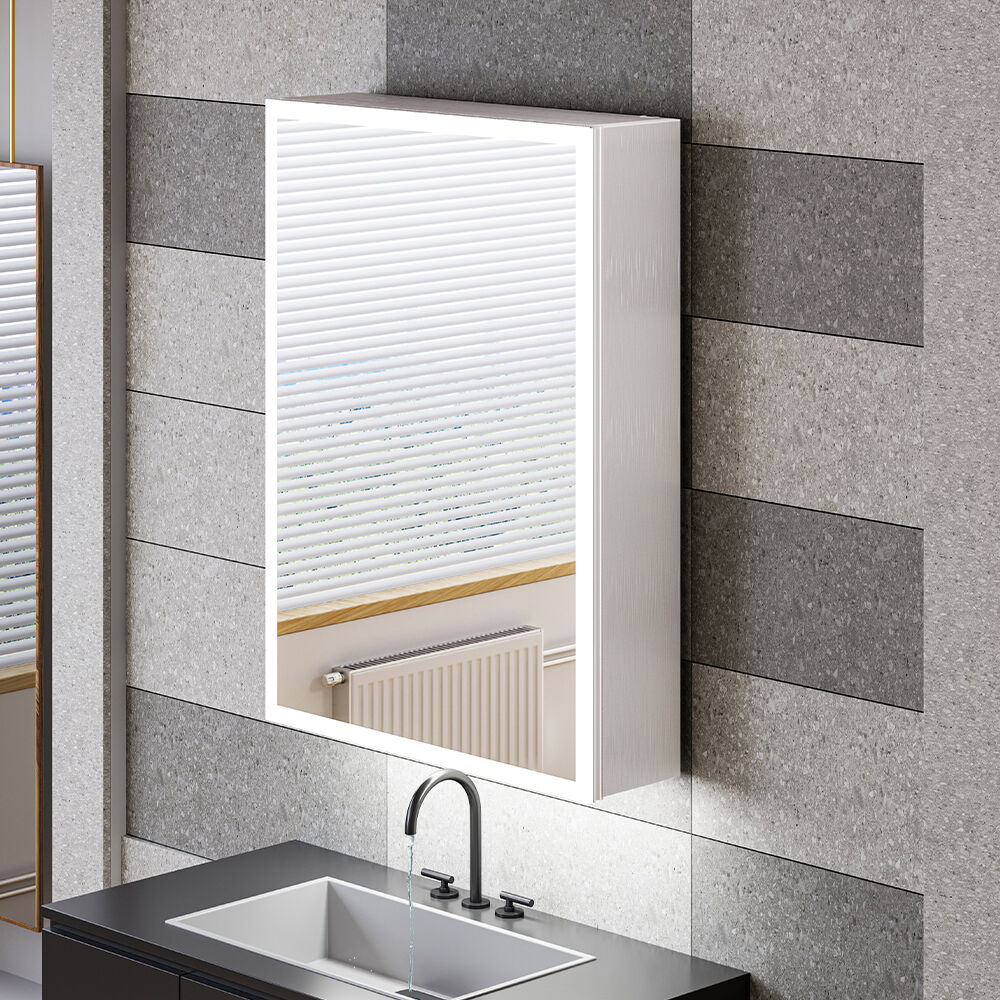
How Anti-Fog Technology Actually Works in Bathroom Mirror and Cabinet Systems
Heated Element Systems: Mechanism, Response Time, and Real-World Efficacy
Fog prevention works when heated elements raise mirror temps past the dew point, usually keeping things around 2 to 3 degrees warmer than surrounding air. That tiny difference makes all the difference in stopping condensation from ever forming on surfaces. Most units run on low voltage DC power between 12 and 24 volts. They kick in pretty fast too, about 3 to 7 seconds after activation, while using roughly the same amount of power as regular LED lights. Many models come equipped with built in humidity sensors that adjust power consumption accordingly, plus automatic shut off features for safe operation inside closed cabinets where heat buildup could be problematic. These systems generally perform well even when humidity hits 80% or higher, but their effectiveness drops off significantly once ambient temperatures fall below 10 degrees Celsius because the system has to work harder against colder conditions.
Hydrophilic Coatings vs. Active Ventilation: Pros, Limitations, and Compatibility with Cabinets
Hydrophilic coatings function without any external power source by changing how water interacts with surfaces at a molecular level. The silicon dioxide nanoparticles actually help spread moisture out into this really thin film that's practically invisible. These coatings don't need electricity and aren't hard to keep up with maintenance wise, though they do tend to wear down after around 1,200 cleanings or so. Most people find themselves needing to apply new coating somewhere between three to five years down the road. On the flip side, active ventilation systems fight fog differently by blowing air exactly where it needs to go. This approach works well for both bathroom mirrors and those completely sealed storage cabinets. The good news is these systems cut down on cabinet humidity about forty percent quicker compared to passive solutions, which means less chance of mold growing inside. But there are tradeoffs too. Active systems need constant power ranging from fifteen to twenty-five watts and proper installation involves routing ducts carefully through framed walls. And let's not forget the noise factor either. Fans run at thirty-five to forty-five decibels, something that might become annoying in quieter bathroom environments.
| Technology | Fog Prevention | Cabinet Compatibility | Energy Draw |
|---|---|---|---|
| Hydrophilic Coatings | Moderate | Limited (surface-only) | 0W |
| Active Ventilation | High | Excellent (whole unit) | 15-25W |
Hydrophilic solutions suit compact or shallow cabinets where airflow is impractical, while ventilation excels in deeper, sealed units—provided acoustic and spatial constraints are addressed.
Integrating Anti-Fog Functionality into LED Bathroom Mirrors and Cabinets
Dual-Purpose LED + Demister Circuits: Power Efficiency, Heat Distribution, and Safety Standards
Integrated circuits today bring together LED lighting with demisting capabilities all in one compact system, cutting down overall energy usage by around 30 to 40 percent when compared to having these features separately according to research published in Home Energy Journal last year. The conductive backing helps spread heat evenly over mirrors so there are no cold areas left where fog tends to hang around. For bathrooms, these combined units need to pass IP44 ratings against water splashes as part of basic safety requirements. They also come equipped with built-in thermal protection that kicks in if things get too hot inside those tight cabinet spaces. When manufacturers merge the power components like drivers and transformers, they cut out unnecessary wires, make installations much easier, and keep mirrors crystal clear right after someone finishes their shower without waiting for them to clear naturally.
Hardwired Installation Requirements for Bathroom Mirror and Cabinet Units
Getting anti-fog mirrors and cabinets installed properly requires professional wiring work since they need to meet specific electrical standards for areas near water. These devices typically run on a dedicated circuit because they draw power continuously at around 15 to 25 watts. Also important is having ground fault circuit interrupter (GFCI) protection no more than 1.5 meters away from any water source. Installing these systems can get tricky when it comes to hiding the electrical connections inside cabinets. The junction boxes have to fit both the LED driver and the demister transformer, which becomes really difficult in those slim cabinets that are less than 100mm deep. Custom mounting solutions usually become necessary in these cases. People trying to install these themselves without proper knowledge risk creating dangerous situations. According to the National Fire Protection Association, nearly half (about 42%) of all electrical problems in bathrooms come from badly done mirror cabinet installations.
Designing Bathroom Mirror and Cabinet Systems for Optimal Fog Resistance
Cabinet Depth, Sealing, and Ventilation Trade-Offs in Framed and Recessed Units
Optimizing fog resistance hinges on balancing cabinet depth, sealing integrity, and ventilation strategy. Deeper cabinets (over 6 inches) improve insulation around heating elements—cutting energy use by 15-20% versus shallow units—but can restrict wall cavity airflow near plumbing penetrations, inadvertently increasing localized condensation risk.
Proper sealing keeps sensitive electronics and stored items safe from humidity problems. Silicone perimeter gaskets work pretty well for this purpose, but they need good ventilation too so we don't trap warm moist air inside. Recessed units present bigger issues because their flat mounting restricts airflow at the back. For these installations, adding side vents or small fans becomes necessary to stop condensation from forming behind the mirror surface. Framed cabinets actually give us more options for passive ventilation through gaps in the design, although there is some compromise on appearance. No matter which cabinet style gets chosen, incorporating moisture wicking materials into shelf construction and back panels makes the whole system much more durable over time. This works best when combined with actual anti fog tech solutions that actively combat condensation formation.
| Design Factor | Framed Cabinets | Recessed Cabinets |
|---|---|---|
| Ventilation | Passive gaps (optimal) | Forced airflow required |
| Sealing | Perimeter gaskets only | Full moisture barrier |
| Condensation Risk | Low (air circulation) | Moderate to high |
Key Selection Criteria for High-Performance Bathroom Mirror and Cabinet Solutions
Verified Performance Metrics: Energy Use, Warm-Up Time, and Long-Term Durability Testing
When selecting high-performance anti-fog systems, prioritize verified metrics—not marketing claims. Energy-efficient models operate at under 15W—equivalent to a standard LED bulb—and deliver up to 40% lower electricity costs than conventional demisters. ENERGY STAR® certification or equivalent third-party validation provides reliable assurance of efficiency.
Warm-up time directly affects usability: premium systems achieve full defogging in under 90 seconds, preventing fog accumulation during showers while minimizing energy waste. Independent testing confirms ceramic heating elements outperform metal coil variants by 30% in thermal uniformity—critical for edge-to-edge clarity.
Long-term durability is validated through accelerated testing simulating five years of real-world bathroom conditions. Manufacturers should provide third-party verification reports for:
| Test Parameter | Performance Benchmark | Industry Standard |
|---|---|---|
| Moisture resistance | 95% RH continuous operation | IPX4 rating minimum |
| Coating adhesion | 500+ wipe cycles | ASTM D3359 Method B |
| Thermal shock resistance | -5°C to 55°C cycling | IEC 60068-2-14 |
Units lacking transparent, third-party data for humidity endurance should be avoided—performance gaps in any of these areas compromise both functionality and service life.
FAQ: Anti-Fog Bathroom Mirrors
What is the main function of anti-fog technology in bathroom mirrors?
Anti-fog technology primarily aims to prevent the formation of condensation on mirror surfaces, ensuring the mirror remains clear and usable even in high humidity environments.
How do hydrophilic coatings work?
Hydrophilic coatings alter how water behaves at the surface level, spreading moisture thinly across the surface, which reduces fogging naturally without the need for any power source.
What are the installation requirements for anti-fog mirrors?
These mirrors typically require professional installation to ensure they meet specific electrical safety standards, particularly for areas near water.
Is there a difference between heated element systems and active ventilation methods?
Yes, heated element systems use low voltage to warm mirror surfaces above the dew point, while active ventilation uses airflow to reduce humidity levels directly, often in cabinetry.
Table of Contents
- How Anti-Fog Technology Actually Works in Bathroom Mirror and Cabinet Systems
- Integrating Anti-Fog Functionality into LED Bathroom Mirrors and Cabinets
- Designing Bathroom Mirror and Cabinet Systems for Optimal Fog Resistance
- Key Selection Criteria for High-Performance Bathroom Mirror and Cabinet Solutions
- FAQ: Anti-Fog Bathroom Mirrors